Showing posts with label grief. Show all posts

Monday, 24 August 2020

between the bushfires and the pandemic, hope springs

An Environmentalist on Having Children

A recent article in The Conversation suggests there will be no Covid Baby Boom in Australia, despite many lucky couples celebrating more adventurous sex lives during the pandemic. It cites reasons such as economic uncertainty, relationships being more strained by forced togetherness (highlighted by the horrific statistics of increased domestic violence during lockdown), and the postponement of elective medical procedures, including IVF. Other research from the US shows 34% of surveyed women said the pandemic was stopping them from getting pregnant or having another child, primarily due to the uncertainty of the future in terms of jobs, healthcare and childcare. 


These stories have reminded me of the growing group of environmentalists who are remaining child-free by choice*. In the UK, the Birthstrike movement demands system change and shares personal, often heartbreaking, stories from its members on how they decided to not have children in relation to the planet's ecological destruction. There is a similar movement in the US called Conceivable Future that includes video testimonials. I greatly appreciate that both these movements give people the opportunity to share their personal stories and speak their truth, even if that truth remains in the "I'm still undecided" category. Many environmental campaigners and journalists have also shared their thoughts and anxieties around the choice to have children (or not).

As someone entrenched in the environmental movement I completely relate to those who share their thoughts on the taboo subject to be child-free by choice in a world that celebrates reproduction. One of the most common reasons discussed is the morality of bringing children into a world that will be largely uninhabitable by the end of the century if radical climate action does not occur within the next decade. When Australia was experiencing the devastating bushfires this past summer, I was consumed with anxiety and sadness at the world that awaits my son, who is now just 2 1/2 years old. I don't think I will ever forget the particular evening we watched ash falling like black snow against a fire-tinged orange sky. And I hope I don't forget it, such a powerful reminder that the climate has already changed, and urgent action is required to halt its progress toward even more devastating ends.

Another common reason for choosing to be child-free is to avoid bringing another "superconsumer" into the world, particularly the industrialised nations where these movements are most vocal. I write this from the comfort of my first world home complete with WiFi, lighting, heaters, devices, furniture and so much stuff. Even as a climate activist my lifestyle has a heavy footprint, and the last time I measured it would take 1.7 Earths to sustain my lifestyle (the average Australian lifestyle uses 5.2 Earths - meaning, if everyone on the planet lived like Aussies we'd need 5.2 planet earths to sustain us). Bringing another western "superconsumer" into the world is hardly a pro-environmental act. 

And yet, despite these very valid concerns, I never considered not having a child for environmental reasons. In fact, I actively pursued reproduction. My first child was conceived via IVF after years of "unexplained infertility", multiple tests and treatments. And last year I had two surgeries to address complications from my son's birth because without doing so I would never be able to have another child. Even after the devastation and resulting fear from the summer's bushfires, I scheduled an appointment with my fertility specialist to start another round of IVF to try for Baby #2 in February of this year.

And then 2020 continued to unfold in surprising ways. 

Somewhere between the bushfires and the pandemic, and before my IVF cycle could begin, I became unexpectedly pregnant.** 

I view this surprising, joyful, twist of fate emblematic of the way I view parenthood in the time of climate change - a brazen sign, or act, of hope. Even though the familiar climate horror stories initially inspired my involvement as an activist, I have never once thought we couldn't solve the problem. Never.

This doesn't mean I think everything is solved, or that we can afford to be personally or politically complacent. But that I know collectively humans have the knowledge, willpower and tenacity to overcome the climate crisis. I know, I know, I hear your concerns...
  • There are conservative and corrupt governments to overcome.
  • There are covert corporate interests that interfere with our governments that also attempt to greenwash us with beautiful climate commitment statements.
  • We continue to emit dangerous levels of greenhouse gases, even during the pandemic.
  • There are countless issues of biodiversity loss, drought, and planetary health to address.
But, we also have:
  • A growing, powerful youth climate movement.
  • A robust Indigenous climate movement.
  • Growing awareness of the many effective grassroots environmental justice programs led by BIPOC.
  • Thousands (or is it millions?) of scientists, engineerings, social scientists, writers, and other experts and activists finding solutions all across the globe.
As a result, the culture is changing.

I've said it before, but one of the great privileges of my work is meeting with people who are actively improving the world. Often quietly, behind the scenes, no fanfare (no Instagram!), just hard work, often unpaid and voluntary. So in addition to my naturally optimistic view of the world, I am lucky to be surrounded by signs of hope (as long as I don't linger on social media or the news for too long). I don't mean to discount the feelings or fears of others who have chosen the alternate view, and of course there's a chance I could be wrong, but I genuinely feel the best is yet to come for humanity. You can feel change in the air (even amongst a global pandemic, or perhaps it's enhanced because of it).

I yearned for a family for a myriad of reasons, not at all connected to the environment (except, perhaps, wanting to share the love I have for the natural world with the next generation). But I do consider the fact that I am an active environmentalist having a second child to be an act of hopeful rebellion. I refuse to accept we have lost. I remain ever hopeful that we are pulling ourselves toward a cleaner, safer future. And now I will have one more reason to continue dedicating my life to the cause. And just maybe, if I do my parenting job correctly, I'll have the privilege of raising two humans with a generous, selfless, compassionate, collaborative, justice-oriented worldview (no pressure, kids).

xx Lisa


* Please note, I am writing specifically about people who actively choose to be child-free, and I am deeply sorry if this post triggers difficult emotions for anyone experiencing infertility or being child-free for any other reason.

**My intention here is not to provide any false hope to anyone experiencing infertility, or to offer one of those stories we're so often told to try and give us hope that miracles can happen. My heart truly goes out to anyone who has ever dealt with the emotional reality of infertility. I merely aim to tell my full story here.

Friday, 10 January 2020

and the fires rage on


The Australian bushfires have left a wake of devastation across the country, and the fires blaze on. Greater Sydney has experienced numerous apocalyptic days over the past few months but – aside from people with respiratory and cardiovascular issues – we are the lucky ones. Our homes still stand. Our businesses and jobs are in tact. We even had (nearly) blue skies over the Christmas break, making it possible to momentarily forget about the destruction of our beautiful country. But one whiff of smoky haze or quick social media check wrenches us back to reality.
Sometimes I think, “Well, soon all of the national parkland will be burnt and so at least the fires will stop.” Some sort of twisted rationale my mind has come up with to help deal with what is happening. Willing the smoke, the haze, the ash, the constant reminders that our nation burns as the climate fiercely changes, willing all of it, to stop. But I know it won’t, not yet, this is early bushfire season in Australia.

In actual fact, estimates suggest nearly half of all the country’s forests will have burnt by the time this bushfire season is over. Half. How do we even wrap our heads around what this means in terms of habitat and wildlife loss? Greenhouse gas emissions? People’s livelihoods? The Australian bush is varied, diverse, and so incredibly beautiful. Although I grew up in another incredibly beautiful part of the world (hello Rocky Mountains!), it wasn’t until I moved to Australia that I truly fell in love with the natural world. The bush is a place of magic and wonder, and I crave immersing myself in the forests on a regular basis. I haven’t yet ventured toward any burnt areas, safe in my urban beachside bubble, but accounts from people flying over the smouldering land and driving through the scorched earth are bracing me for a barren and blackened landscape, unrecognizable from the bush I know and love.

It’s near impossible, to imagine what the people who live in these areas of the country and have lost everything – their homes, businesses, possessions, even loved ones – are experiencing. There are beautiful and powerful written accounts, like this one by author Jackie French who praises the leaders who have emerged in place of our nation’s so-called leaders, that start to put into perspective what life has been like these past couple of months. And many others who highlight the very long, unknown, road to recovery for so many of these communities that have been decimated by the fires.

Like so many Australians, I’ve felt powerless in terms of what I can do to help. I have gladly donated money, knowing that is what is most needed right now, but it can feel like it’s not enough. There’s an ache to get out and be useful, and yet how can I be useful in a time like this? It’s dangerous. Fires still blaze. I have zero emergency skills, unlike the firefighters* and other first responders who are (as they so often are) the saviours of the nation.

There are, however, many clearheaded people who have already sprung into action and offer ways to be involved. Some of the initiatives that have caught my attention include:
  • Knitting and sewing for wildlife – mittens, pouches, possum boxes, nests, and more. Thousands of people from around the world are putting their knitting and sewing skills to help injured and orphaned animals recover. The Animal Rescue Craft Guild has more information on what is needed and patterns to help you create the needed items.
  • ThreadTogether is an initiative that collects unworn/unsold items from retailers to distribute to people in need. They have ramped up their efforts in the wake of the crisis to collect even more for those communities impacted directly. If you are a designer or retailer with unsold items, get in touch with them ASAP.
  •  Go with Empty Eskies campaign, a viral facebook post by Tegan Webber that urges us to head to the regions as soon as its safe and buy all the food and drinks (and everything!) we need from those communities.
  • Spend with Them Instagram campaign, partly inspired by the Empty Eskies campaign, which highlights businesses in effected areas that need our dollars to keep afloat. If you are in the market for something, why not start there?
  • Authors for Fireys  is a Twitter auction that channels funds directly to the firefighters with authors from around the world auctioning signed books, character namings, lunch dates, workshops and more. I haven’t put my hand up for this only because my book is old news, but I'll try and get myself organised (it ends tomorrow!) to offer a sustainable fashion workshop in exchange for donations.
  • Hearts on Fire instagram auction of experiences from fashion, food, travel and the arts to raise money. Incredible things up for auction here!
  • Yesterday more than 45 Australian retailers participated in the "All In" campaign, donating 100% of their profits to the Red Cross bushfire campaign. It was good timing for me - I needed some new work clothing so spent it all with the Iconic (which is also going to be offering its warehouse to store donated items over coming months to assist the charities that have been inundated with goods).

It’s hard to know what to write, and how to respond, except to say that I’m heartbroken, saddened, frightened and angry. I’ll continue to do what I can, to act thoughtfully yet forcefully for change. I’ll be at the protests today in Sydney, hope to see some of you there, too.

xLisa

Wednesday, 11 December 2019

tis the season for a revolution


In previous years I've written guides and given advice about choosing sustainable holiday gifts. You know, buy from ethical, local, Fair trade suppliers and artists. Choose pre-loved items. Give someone an experience instead of an object. Cook a meal, babysit kids, plant a tree, make organic body scrub. And wrap it all in sustainable gift wrap.

I still wholeheartedly believe in those options. And - despite what the rest of this post may suggest - I really do love the holiday season. Love it. There is nothing better than enjoying delicious food and the company of loved ones under the twinkle of fairy lights. As an added bonus, living in Sydney means that Christmas is the perfect excuse for an extended summer break at the beach. Bring. It. On.

But this year, instead of hoping santa brings me a gorgeous sustainable frock and fretting over the 'perfect' gift for my loved ones, I want something bigger. I want a revolution. I want a seismic cultural and political shift to address the growing climate crisis. It's not too much to ask, is it?


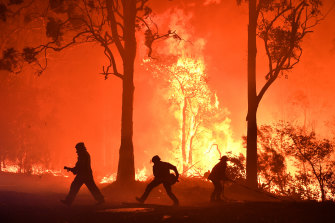
My state is literally on fire. Look at these photos. That extended summer break I mentioned before will likely be spent indoors to escape the hazardous smoke pollution which periodically blankets the city. The fires have come so early and so fiercely that fire chiefs are making public declarations about climate change and begging the government to address the climate crisis. And what does our Prime Minister do? Offers platitudes, thoughts & prayers, naively comments that volunteer firefighters don't need to be paid because they "want to be there" and uses the opportunity of our nationwide distraction to axe the federal arts department and splitting the energy and environment portfolios into other, larger, portfolios, all but ensuring climate change doesn't get a look in. Shame.

The Currowan bushfire has been raging for days in a national park near Ulladulla, burning almost 50,000 hectares as of Wednesday, the RFS said.
Photo: AAP via SMH

Halfway around the world other world leaders are meeting for the annual COP climate talks. I freely admit to being particularly ambivalent about the talks this year. Which is unfair - many people work tirelessly in the lead up and throughout the talks to convince nations to make binding agreements to emissions reductions. But from my perspective (and at least one top scientist) it just looks like we've had these talks for over 20 years and global emissions are rising year on year. Countries including Australia and the United States shirk responsibility and forfeit the opportunity to become climate leaders. And remind me, how many people took an international flight (and how many business class, or private planes) to attend the talks? Not Greta, obviously, and though it doesn't make a dent in the grand scheme of greenhouse gas emissions, it does have an impact on the power of one's activism and leads to systemic change.

So needless to say, this holiday season I'm distracted. Instead of teaching my toddler about the magic of the season I'm fretting about his future. I don't want the champagne and baubles and bonbons - well, not as much as I usually do, anyway. I don't have the energy to handcraft gifts and I don't feel the same joy listening to Mariah Carey's "Merry Christmas" album as in previous years. I want global leaders to act just as that - leaders - and to take the bold actions necessary to halt the worst of the project climate disasters. We are seeing too frequent glimpses of them already, and frankly, it's terrifying.

But I hear you. You want a list. You want a guide for an ethical holiday season, so here it is:
  • Change your household energy to 100% renewable energy. There are multiple affordable options available making this option more attainable than ever.
  • Divest your retirement/superannuation. There are a variety of funds options that do not invest in fossil fuel companies but do have competitive returns. Make your money work for the future you want.
  • Ask your workplace about their own energy and investment plans, and work with them to make the necessary changes if not enough is being done.
  • Contact your politicians. Relentlessly. Let them know the climate is a top concern of yours, and if it's not theirs they will not get your vote.
  • Volunteer your time.
  • Donate your money. This year there are a variety of bushfire appeals including for Fire Services and wildlife rehabilitation. If any of my loved ones want to know what to get me, please do this for me.
  • Connect with others. Build your community and look after those who need some extra care.
  • Rest as much as you can, we have a lot of work to do in 2020.
Until then, fellow Revolutionaries, 
xoLisa

Friday, 29 March 2019

environmental melancholia: part one

I'm taking a serious turn in this blog post to talk about the grief, anxiety and apathy that can accompany environmentalism. It can come about from working in the area or as a result of hearing endless news reports about the climate, drought, rising sea levels, deforestation, you name it. It is sometimes referred to as ecological grief or environmental melancholia.

Good times at the beach?


This post has been on my mind for awhile, and though I'm sure I won't communicate everything I want to about it, I figured I may as well just dive in and get the conversation moving.

For example, I started writing a post in January (and because of working-motherhood never returned to), and it included the following:
As I've awakened on another steamy Sydney morning, during this summer of record-breaking heatwaves, I find myself thinking about the future. As a climate activist it's hard not to make the connection between these extreme weather events and our changing climate. Not to sound too apocalyptic or anything, but the early stages that climate experts have been warning about for decades are starting to occur. 
One-third of Australia's flying fox population died in a two-day heatwave last November. In addition there has been the mass death of hundreds of thousands of fish in the Darling River due to extreme heat and low river flow, and over 100 wild horses perished in extreme South Australian heat this past week. This is what biodiversity loss as a result of climate change looks like. I'm not going to sugar coat it, it is bleak.

Uplifting stuff, right?

Ugh.

I've also started working on a new project with the Sydney Environment Institute and speaking with a number of sustainability researchers from all faculties on campus. Normally talking to brilliant minds who are furiously working on climate and environmental issues energises me. But every now and then I realise, some of these people have been working on this stuff for decades. And we are still in a global political stalemate over concrete and revolutionary action (and it's only revolutionary because we have waited for decades to extricate our lifestyles from fossil fuels after learning of their impact - don't even get me started on that issue).

Oh yeah, the latest UN IPCC report was a real doozy, too. Did you miss it? The key takeaway is that we need to enact swift and immediate action to avoid catastrophe. We will reach a world of 1.5 degrees warming in 12 years (we've already reached 1 degree), at which point several hundred million human lives are at stake. I've taken the following from Grist:
We only have a decade left to finish our initial coordinated retooling of society to tackle this challenge. The scientists were quite clear about this. By 2030, we’ll need to have already cut global emissions in half (45 percent below 2010 levels, according to the report), which (again, according to the IPCC) would require “rapid and far-reaching transitions” in “all aspects of society.”
The language in this report is markedly more urgent than anything they've published before, which should highlight the gravity of the issues.

And then last night I was playing with my son at the beach, and as he was being adorable, crawling about on the sand, exploring the seashore, he made his way to give me something - a little styrofoam ball. How depressing. Is it human nature to clean up the planet? Or, more likely, he's watched his dad and I religiously take 3 (or 12) for the sea every time we are at the beach. This is something I wish I didn't have to teach my son, to clean up polluting litter from the beach and oceans. Let alone what's to come as the climate continues to change throughout his life (I must blog another time about the decision to procreate in a time of climate crisis).

So there you have it. Some of the causes of my current state of environmental melancholia. I have started reading a book of that same title by the very clever psychologist Renee Lertzman, and will give you a mini book review in the next post. I'll also share insights from other experts in the area, in case you have also experienced similar feelings of grief or anxiety.

As environmentalists or activists or simply humans living in this changing world, it is important to look after ourselves, acknowledge our emotions, and learn how to help each other move forward, don't you think?

More soon,
xLisa